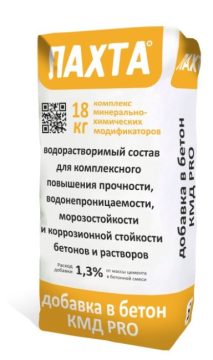
LAKHTA KMD PRO concrete admixture — complex modifier for concretes and mortars
Mineral-chemical modifier for Portland cement concretes and mortars: water impermeability from W2 to W16 according to laboratory tests.
The BP-G35 grade is used in regions where the coldest five-day period is warmer than −25 °C, and where it reaches −25…−35 °C: its flexibility temperature is not higher than −41 °C. The sealant fills expansion joints of concrete and asphalt concrete pavements of runways and taxiways, joints and cracks of roads, and expansion joints and drainage of bridge structures. It is poured heated to +140…+180 °C onto walls primed with Izhora NP-02. At −20 °C the material elongates by at least 394 %, and it withstands 31 thousand loading cycles at 0 °C.
| Manufacturer | Rastro (LAKHTA, SLAVYANKA, Izhora) — ZAO “Rastro” |
|---|---|
| Type | joint sealants |
| Use | joints and junctions, bridge structures |
| Base | one-component hot-applied bitumen-polymer sealant (bitumen, plasticisers, polymer additives) |
| Colour | black |
| Packaging | 24 kg cardboard drums with polyethylene film or 25 kg cardboard boxes with release film |
| Application method | remove loose pieces, crumbling concrete and old sealant; clean the joints with a disc brush and compressed air, dry with a gas or infrared torch; treat the walls with Izhora NP-02 primer; remove the packaging (from blocks in boxes — also the release film); heat in kettles with forced agitation to +140…+180 °C without overheating or direct heating; pour with joint-filling machines or pouring cans to a level 3–5 mm below the pavement surface; filling depth to width 1:1…2:1, with a backer rod; after pouring — mineral dusting; traffic — after cooling |
| Application temperature | surface and air not lower than +5 °C, no precipitation (at lower temperatures — with heated enclosures or heat guns); working temperature +140…+180 °C |
| Curing | traffic is opened after the sealant has cooled to air temperature and no longer sticks to wheels |
| Key properties | flexibility temperature not higher than −41 °C; softening point (ring and ball) not lower than 90 °C; tack temperature not lower than 54 °C (with dusting 60 °C); elongation at break at −20 °C at least 394 %; water absorption not more than 0.29 %; climatic zones I…IV; fatigue endurance at 0 °C 31 thousand cycles; UV ageing 1,000 h — weight loss 15 %; heating in kettles +140…+180 °C; compliance with GOST 30740-2000; prolonged contact with organic solvents, oils, highly concentrated acids and alkalis is not recommended |
| Consumption | 0.9 kg/linear m per 20 × 40 mm joint |
| Shelf life | 24 months from the date of manufacture |
| Standards | TU 5772-009-11149403-2002; compliance with GOST 30740-2000 |
Data from the manufacturer’s technical data sheet. The coating system, number of coats and quantity are selected for your project on request.
Mineral-chemical modifier for Portland cement concretes and mortars: water impermeability from W2 to W16 according to laboratory tests.
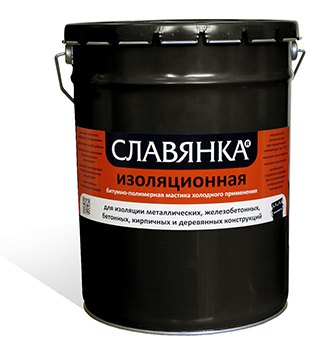
Bitumen-polymer mastic for protecting pipelines, tanks and underground structures from moisture, soil corrosion and stray currents.
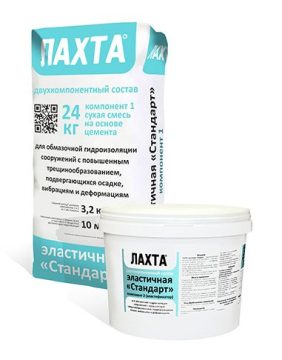
Two-component elastic waterproofing for structures with cracks, settlement and vibration; bridges cracks up to 1 mm without reinforcement.
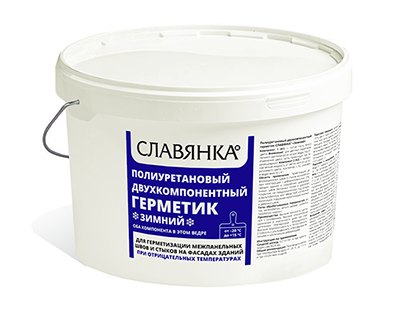
Winter polyurethane sealant for expansion and panel joints, applied at air temperatures from −20 to +15 °C.
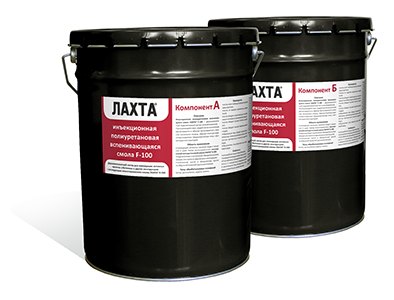
Elastic injection resin for sealing dry and damp cracks, joints and butt joints, including moving ones; viscosity 150 mPa·s.
Penetrating cement mix for foundations, basements and tanks that raises the water-tightness grade of concrete by 4…6 steps.