LEVL (INGRI)
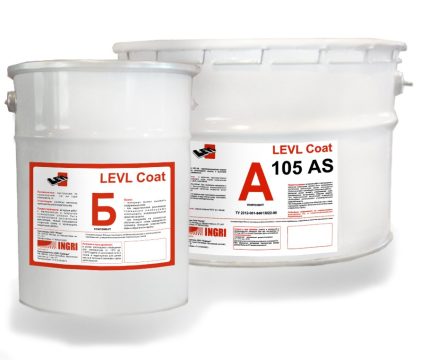
LEVL Coat 105 AS — conductive primer for antistatic floors
Water-based epoxy conductive layer over the copper circuit in LEVL antistatic floors; electrical resistance 10³–10⁵ ohm.
Price on request
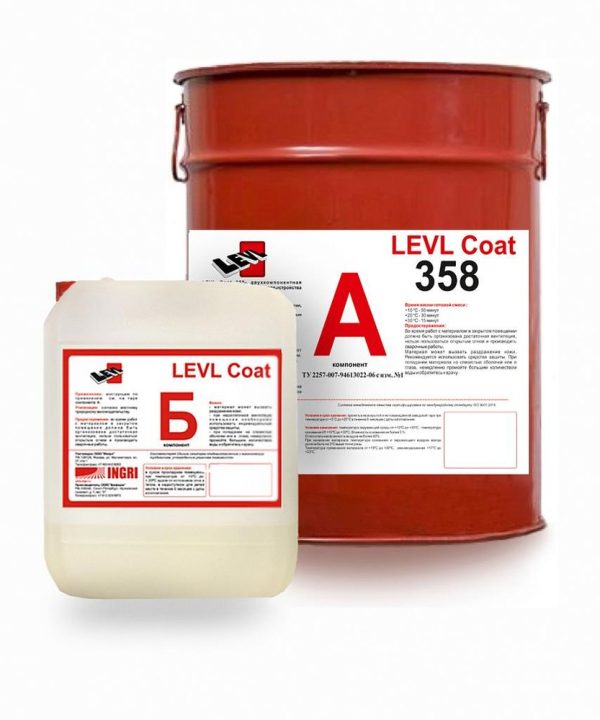
Elongation at break of at least 50 % allows LEVL Coat 358 polyurethane coating to bridge cracks in concrete. The two-component compound is poured in one layer over LEVL Coat 108 or 151 primer, optionally finished with LEVL Coat 254 matt varnish; with sand the coating becomes stronger. Taber abrasion is up to 60 mg, Shore D hardness from 55, service from −25 to +60 °C. It suits workshops, warehouses including cold ones, energy, transport and agricultural facilities, schools, healthcare and sports institutions.
| Manufacturer | LEVL (INGRI) — OOO “Ingri”, Saint Petersburg |
|---|---|
| Type | polyurethane floors |
| Use | production workshops, retail and public buildings, warehouses and logistics, chemically resistant |
| Base | polyesters, fillers, pigments, special additives + aromatic polyisocyanate (two-component) |
| Colour | RAL K-7 colour chart |
| Packaging | kit A+B = 30 kg (A: 20 l metal pail, B: 5 l jerrycan); A : B = 5.9 : 1 (by weight) |
| Application method | wear-resistant single-layer self-levelling coating that bridges cracks in concrete; with sand, of increased strength; over LEVL Coat 108 / 151 / Wetisol S-MP1 primer; pouring, squeegee or notched trowel, spiked roller; optionally LEVL Coat 254 matt varnish |
| Application temperature | air +10…+30 °C (recommended +17…+23 °C); substrate +10…+30 °C (recommended +15…+25 °C); material +15…+25 °C; air humidity up to 80 %; substrate moisture no more than 5.0 % by weight (primers 108/101/103) or 4.0 % by weight (151, Wetisol S-MP1); 3 °C above the dew point; with sand, work at +17…+23 °C |
| Curing | light foot traffic: +10 °C ~32 h, +20 °C ~16 h, +30 °C ~12 h; light loads ~6 / ~3 / ~2 days; full strength gain ~10 / ~7 / ~5 days; next coat after 12–48 h at +20 °C |
| Key properties | Taber abrasion resistance (CS10/1000 g/1000 rev.) no more than 60 mg; Shore D hardness at least 55; relative elongation at break at least 50 %; tensile strength at break at least 7 MPa; adhesion at least 2.5 MPa (failure in the concrete); mix density 1.66 ± 0.1 kg/dm³; non-volatile content at least 98 %; pot life at least 30 min (+10 °C ~50 min, +20 °C ~30 min, +30 °C ~15 min); service temperature from −25 to +60 °C |
| Layer thickness | admissible 1.5–5.0 mm; in highly filled systems 3.0–12.0 mm |
| Consumption | theoretical 1.66 kg/m² at 1 mm thickness; 1.5 mm layer: 2.5 kg/m² (+ LEVL Coat 254 matt varnish 0.08 kg/m², optional); 2.5 mm system: LEVL Coat 358 3.04 kg/m² + quartz sand 0.1–0.3 mm 1.52 kg/m² |
| Shelf life | 6 months from the date of manufacture; storage at +5…+25 °C |
| Standards | TU 2257-007-94613022-06 with Amendment No. 1; coating requirements per SP 71.13330.2017 Table 8.12; test methods GOST 31992.1, GOST 31939, GOST 28574, GOST 24621, GOST 11262 |
Data from the manufacturer’s technical data sheet. The coating system, number of coats and quantity are selected for your project on request.
Water-based epoxy conductive layer over the copper circuit in LEVL antistatic floors; electrical resistance 10³–10⁵ ohm.
Carboacrylate finish for MMA systems with coloured filler, indoors and outdoors; Taber abrasion no more than 45 mg.
The range's main epoxy self-levelling floor for warehouses, workshops, car parks, healthcare and food production; compressive strength 63 MPa.
Solvent-free primer for concrete aged from 7 days and damp substrates, a temporary moisture barrier under polymer coatings.
Thin-layer PU-cement coating and sand seal coat in PoliCem systems for food and chemical workshops; Taber abrasion up to 60 mg.
Polyethylene fibres that make carboacrylates, adhesives, sealants and coatings thixotropic; chemically resistant, asbestos-free additive.